As we reach the end of 2025, I find myself looking back not just at milestones, but at momentum. Twelve months ago, we knew what we had to do: secure the foundations, sustain the platform, welcome new contributors, and prepare for a future defined by extensibility, openness, and AI.

The Eclipse Foundation’s three Working Groups in the developer tools space: Eclipse IDE, Open VSX, and Cloud Dev Tools, moved forward, together.Contributors showed up. Users engaged. Members committed. From meetups to releases, from restructuring to recognitions, 2025 was the year we turned intent into traction.
Let’s take a look at what shaped this year: and what it means for the road ahead.
🧭Eclipse IDE: Sustained Releases, New Contributors, and Platform Renewal
The Eclipse IDE stayed true to its cadence this year, delivering four successful Simultaneous Releases; in March, June, September and December, with project participation peaking at 270 contributors in the spring. The December and September releases held steady at 144 contributors, which is below our 200-contributor average but still represents significant commitment.
But the real shift came in community dynamics and long-term platform evolution:
- In February, the IDE Steering Committee reprioritised its roadmap, identifying the need to attract new members, especially those relying on the Rich Client Platform (#RCP) and to expand contributor capacity.
- In March, we celebrated the release of CDT 12.0, featuring a new C/C++ editing experience powered by CDT-LSP
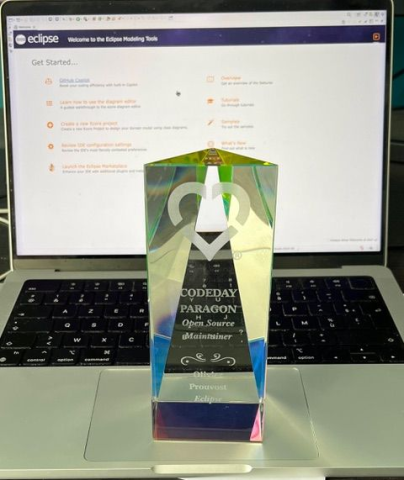
- All year long, Community Mentors, funded by the WG, supported newcomers through a unified entry point for all Simultaneous Relelase projects at 🔗 https://github.com/eclipse-ide Their efforts were recognised with a Paragon Award in Q4
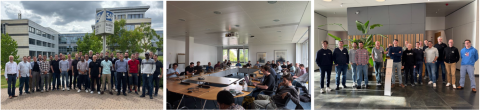
- One standout moment: the collaboration with CodeDay and the Computing Talent Initiative, which gave students their first opportunity to contribute to the Eclipse IDE. 🔗 https://blogs.eclipse.org/post/thomas-froment/students-eclipse-ide-contributors-growing-next-generation-committers
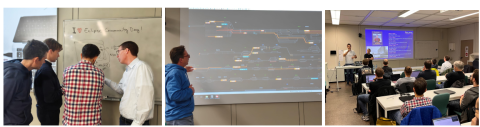
In parallel, 2025 marked the return of physical "Open Community Meetups" (aka "Demo camps" in the past):
- 🇫🇷 Toulouse France, in June
- 🇮🇳 Bengaluru India, in February and September (sold out, with 40+ on the waitlist!)
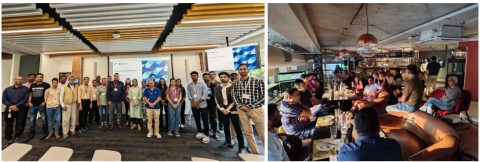
- 🇩🇪 Germany, in July and November gatherings bringing together the Eclipse IDE community and the Java / local iJUG communities.
The GitHub Copilot plugin for Eclipse IDE reached feature parity with its counterparts on other IDEs, and is now available on the Eclipse Marketplace
This new wave of AI interest was also supported by the Eclipse community itself. Several teams began prototyping AI features for the Eclipse IDE, with early coordination happening in this Matrix space: 🔗 https://matrix.to/#/#eclipse-ide-ai-discussions:matrix.eclipse.org
Another major development: the completion of Phase 1 of Initiative 31, the effort to modernise the SWT rendering layer using Skia. The initiative showed that SWT could evolve without breaking RCP compatibility: shifting the problem from conceptual to one of available resources. 🔗 https://github.com/swt-initiative31
☁️ Eclipse Cloud Dev Tools: From Adoption to Recognition
2025 has been a turning point for the Cloud Dev Tools ecosystem, with alignment across adoption, visibility, and innovation.
- Theia AI launched in alpha and immediately raised attention, earning coverage in The New Stack: “Theia AI: The DeepSeek of AI Tooling?” 🔗 https://blogs.eclipse.org/post/thomas-froment/ai-powered-theia-ide-open-source-developer-tools-ai-era
- TheiaCon 2025, held in October, brought together adopters, contributors and vendors. All sessions are available online: 🔗 https://www.youtube.com/playlist?list=PLy7t4z5SYNaQyTt3QT9nddDLIuEiUKPoX
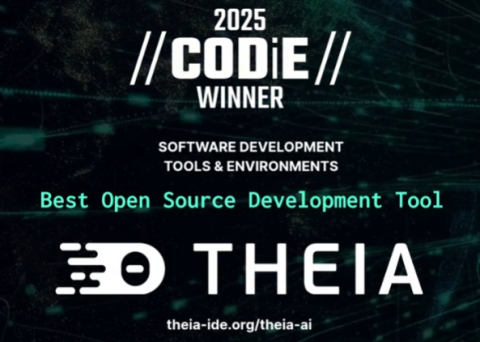
- Theia AI won the 2025 CODiE Award for Best Open Source Developer Tool, a rare recognition from outside the open source world. 🔗 https://blogs.eclipse.org/post/thomas-froment/recognition-openness-theia-ai-receives-2025-codie-award
- The demo video showing Claude + Theia AI integration passed 110,000 views: 🔗 https://www.youtube.com/watch?v=Rou4eiIPrK4
- To answer the ever-present “who uses Theia?” question, we published a growing list of adopters: 🔗 https://www.eclipse.org/topics/ide/articles/the-active-ecosystem-of-eclipse-theia-adopters/
Beyond Theia, the WG celebrated other contributors: community work on Eclipse Sirius Web, EMF Cloud, Eclipse Che, GLSP, Sprotty, MBSE SysOn, without forgetting the C/C++ (CDT) Cloud Blueprint of Theia
2025 also saw Theia AI presented in diverse developer communities:
- OSCAFest in Lagos, Nigeria: our first Eclipse Development Tools presence in West Africa
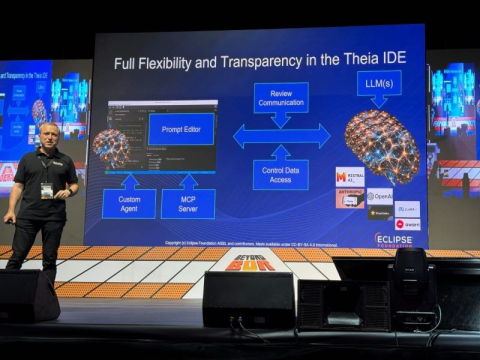
- The Things Conference (IoT) in Amsterdam
- DevOps Goes Native 2025 webinar series
- The LoRaWAN Podcast of MeteoScientific: https://pod.metsci.show/episode/ai-native-toolchains-with-thomas-froment-eclipse-foundation
- Open Source Experience 2025 in Paris
Each of these moments sparked real interest: especially when the audience realised that Theia AI offers:
- a developer UX rivaling VS Code
- compatibility with VS Code extensions
- the freedom to plug in your own AI models and agents, using basically any LLM, including air-gapped setups
- All delivered within a truly open, vendor neutral ecosystem.
🌐 Beyond Theia: a broader Cloud Dev Tools ecosystem
Beyond Theia AI, the Eclipse Cloud Dev Tools Working Group advanced several key projects in 2025, highlighting the breadth of innovation across the ecosystem, just to name a few of them:
- Sirius Web continued to mature as a browser-based platform for diagram-centric modeling, enabling cloud-native, collaborative design workflows.
- Langium introduced Langium AI, bringing generative AI to DSL authoring to accelerate grammar creation and onboarding.
- Eclipse Open Collaboration Tool joined the portfolio to improve distributed collaboration through shared editing, presence, and code context.
Together, these projects show how the Working Group goes beyond IDEs to build the foundations of cloud-native, collaborative, and AI-enabled developer tooling.
📦 Open VSX: From Registry to Strategic Open Infrastructure
In 2025, Open VSX experienced explosive growth, with over 250 million extension downloads per month by November: a fivefold increase compared to 2023. The registry is now a core part of the extension ecosystem for leading AI-enhanced developer tools such as Cursor, Windsurf (Codeium), Kiro (AWS), Antigravity (Google), Bob (IBM), and widely adopted forks like VSCodium.
This growth confirms Open VSX’s role as critical infrastructure, particularly in the era of extensible, AI-augmented developer tools.
To support this evolution, the Eclipse Foundation announced a strategic partnership with AWS to help advance Open VSX as a secure and reliable cloud service. 🔗 https://blogs.eclipse.org/post/mike-milinkovich/aws-invests-strengthening-open-source-infrastructure-eclipse-foundation
2026 will mark a transition year, where Open VSX enters its product phase, with service enhancements, operational readiness, and a delivery structure appropriate to its scale. Yet at its core, it remains an Eclipse open source project: 🔗 https://github.com/eclipse/openvsx
Anyone can contribute, participate in the Open VSX Working Group, or even self-host their own private registry instance. The Working Group, far from fading into the background, will serve as an advisory board for adopters and contributors, helping shape the future of extensibility in developer tools.
It’s not just about releases or repositories. It’s about control.
In 2025, tools like Theia AI, Langium AI, Open VSX started to come together as a composable stack: a stack you can extend, inspect, deploy, and evolve.
For governments, public research, enterprise platforms, and open ecosystems, where vendor neutrality and sovereignty matter, this is no longer a “nice to have”. It’s a necessity.
🔭 Looking Ahead to 2026
We’re entering 2026 with a roadmap and renewed ambition:
- In 2026, Open VSX will officially become a product, delivered, supported and governed like the essential infrastructure it has become. But this is only the beginning. With the scale we’ve reached and the community behind us, it’s hard to say where it will stop.
- Eclipse IDE Working Group and its contributors will need to take even greater care of the platform’s long-term sustainability. We’ve shown what’s possible with focus and collaboration! If your organisation relies on the Eclipse Platform or RCP stack, 2026 is the year to get involved.
- Eclipse Cloud DevTools is bridging modelling, IDE, container-based tooling and AI and the cross-pollination between desktop and cloud dev tools only getting stronger.
It’s clear: the future of developer tools will be open, extensible, and increasingly AI-native. We, at the Eclipse Foundation are proud to help build that future, with our community.
🙏 Thank You
To all the contributors, maintainers, mentors, Working Group members, adopters and first-time committers who made this year possible: thank you.
You're shaping something that matters: and it’s only just beginning.
See you in 2026.


