A year in review and a bold look ahead to 2026
By Sara Gallian and Ansgar Lindwedel
As we steer towards the end of 2025, it’s amazing to look in the rear-view mirror and see just how far the Eclipse Software Defined Vehicle (SDV) community has travelled. What started in 2022 as an ambitious concept – an open, collaborative ecosystem for in-vehicle software – has shifted from the drawing board to the open road. Together, we’re shaping not only the technological future of mobility, but also the way organisations across continents collaborate and innovate.
This year has been one of intense focus, deep collaboration and integration, and major milestones. And as we look toward 2026, the trajectory is clear: the SDV ecosystem is accelerating faster than ever and working towards a common open source platform and architecture for software-defined mobility, built and sustained by a global community.
This flurry of activity is mirrored in an increasing number of community members taking on important roles within the Eclipse SDV ecosystem: three newly appointed Eclipse SDV Ambassadors are helping us spread the word about our efforts both within and far beyond our own community. In addition, as the new Steering Committee Chair, Björn Reistel (ETAS), is leading the committee in setting direction, building consensus, and ensuring that the Working Group operates effectively and transparently within the Eclipse Foundation’s open governance model.
What fuels our optimism for 2026? Let’s take a look at this year’s key roadmarks of progress.
Disclaimer: Please note that these are only a few highlights from the year, with many more activities contributing to the success of the past 12 months. For a comprehensive overview of all numbers and metrics (spoiler: the number of pull requests has nearly doubled compared to 2024!), please see this presentation.
2025: A year of breakthroughs
MoU and Eclipse S-CORE 0.5 alpha: a turning point for our SDV platform vision
In June, the Memorandum of Understanding (MoU) made a remarkable impact across both the automotive and software industries. Initiated by the German Association of the Automotive Industry (VDA), the declaration was signed by 11 automotive companies and intentionally put open source, and Eclipse S-CORE in particular, at its core.
The release of Eclipse S-CORE 0.5 alpha and beta marked one of the most significant accomplishments of the year. Happening not even one year after the project was first announced, and only four months after its official launch, this milestone validated the architectural direction of our SDV platform and provided a tangible foundation for the upcoming 1.0 release. It also united contributors around a shared focus, proving what open innovation can achieve when the community rallies behind a common goal.
Release 0.5 delivers four core modules that lay the groundwork for future series-grade software-defined vehicles:
- Base Libraries (Baselibs): providing common functionality, including basic logging support
- Inter-Process Communication (IPC): enabling reliable and deterministic data exchange between components
- Orchestration: ensuring safe execution across mixed-criticality workloads
- Persistency: securing data storage across power cycles
Most development processes are undergoing external audits and are being prepared to comply with key automotive standards for quality (ASPICE), functional safety (ISO 26262), and cybersecurity (ISO/SAE 21434).
Eclipse S-CORE 0.5 also introduces an open reference platform, first showcased on QNX and Qualcomm hardware, and designed with the flexibility to support multiple operating systems and hardware targets.
Eclipse OpenSOVD: vehicle diagnostics for the masses, with massive momentum
Apart from its meteoric rise in activity and popularity, Eclipse S-CORE also sparked the creation of another new project that is on the way to becoming a center of gravity within the Eclipse SDV ecosystem: The launch of Eclipse OpenSOVD exceeded all expectations, drawing broad participation from OEMs, suppliers, and technology leaders. As OpenSOVD committer Tim Kliefoth (Mercedes-Benz Tech Innovation) explained it in an interview, the S-CORE team recognised a “market opportunity” in the absence of an open-source diagnostics stack built on the new SOVD standard:
“What prompted it was the lack of a good open source automotive diagnostic stack and the clear need for one in the industry. We saw this quite clearly within the Eclipse S-CORE project – there was a strong demand for such a solution. At the same time, there’s been a shift toward SOVD, which is still a relatively new technology compared to older systems based on UDS. So, in a way, it was the right market opportunity at the right time. Additionally, the SOVD standard is based on an ISO standard, which made it the perfect foundation for an open source project, allowing us to work closely with the standard itself and enrich it. For me, it’s really a synergy between the standard and the implementation.”
What could have been a niche initiative or side project rapidly transformed into a globally recognised effort to define and standardise interfaces for vehicle data access. The energy at the kickoff alone has already set the stage for impactful work in 2026, and we hope S-CORE will remain not only a technology platform, but also an innovation incubator that inspires new projects driven by real industry needs.
The X-CORE Platform Council: enabling the projects to focus on releasing the platform
With the establishment of the X-CORE Platform Council, an ad-hoc subcommittee of the Eclipse SDV Working Group, we are now looking ahead and turning our attention to broader integration initiatives. The Platform Council supports complex integration projects, such as Eclipse S-CORE, by overseeing key non-technical activities. While operational teams handle communications, branding, and financial matters, the council provides strategic guidance and leads decision-making to ensure effective project alignment and progress. The X-CORE Platform Council operates under a clearly defined governance structure.
In 2026, we aim to enable the Eclipse S-CORE 1.0 release and maybe even onboard additional core projects, including those emerging in areas such as commercial vehicles or advanced HMI solutions, further expanding the reach and applicability of the ecosystem.
Achievements in functional safety
Eclipse TSF: Successfully assessed to ASIL D
Functional safety also made significant strides along the road travelled in 2025: Achieving a successful ASIL D safety assessment of the Eclipse Trustable Software Framework (TSF) is an extraordinary milestone both technically and symbolically. It demonstrates that open source can meet the highest levels of functional safety, and it establishes TSF as a foundational asset for organisations building safety-critical automotive systems. As Paul Sherwood, Codethink’s Chairman is quoted in the press release:
“This assessment validates that trust in software, especially open source, can be both measurable and auditable.”
The assessment was performed by exida, a globally recognised authority in functional safety. Congratulations to our strategic member Codethink on this important step!
The Eclipse TSF project focuses on practical, scalable ways to understand and quantify risks in software engineering, especially for complex systems that span software, hardware, safety, and security. Instead of relying on traditional, error-prone documentation and requirements tools, TSF introduces a unified methodology built around Tenets and Assertions – structured statements managed directly in a Git repository – that form a directed acyclic graph linking high-level expectations to concrete evidence.
Functional safety process released at the Eclipse Foundation
Alongside TSF, we released the Functional Safety Process at the Eclipse Foundation (it had already been announced in late 2024), giving companies a clear path for contributing to or deploying safety-relevant open source components. This is a significant step in maturing the open SDV landscape and increasing industry trust in collaborative development.
Expanding our global community
Meetups in Korea, Japan, and the USA
Our community events this year were nothing short of exceptional and a true testament to the increasing diversification and global impact of the Eclipse SDV ecosystem. With our new event format, the Open Community Meetups, anyone in our ecosystem can host local, in-person gatherings.
- The first-ever Eclipse SDV community meetups in South Korea and Japan attracted enthusiastic crowds and demonstrated a growing appetite for SDV innovation across Asia.
- The second U.S. meetup in Detroit reaffirmed North America’s central role in the future of SDV.
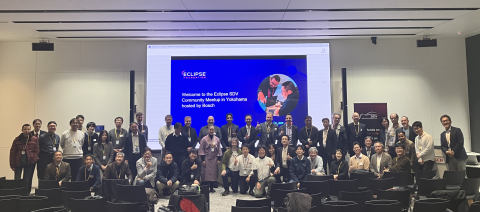
These events showcased what makes this community unique: openness, energy, expertise, and a shared belief in shaping the future together. Special thanks to our members LG Electronics, Bosch/ETAS, and Microsoft for hosting and sponsoring these immensely successful gatherings!
Eclipse SDV Hackathon
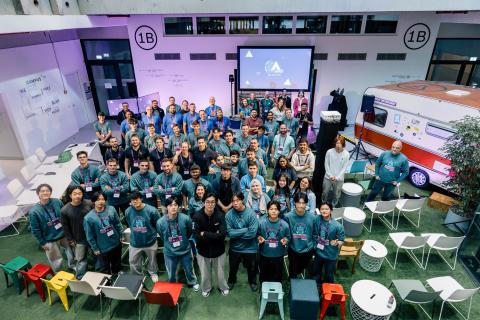
The third Eclipse SDV Hackathon brought together more than 100 participants, for the first time across two simultaneous locations, Bosch Innovation Campus in Berlin and 42 Porto, for an energetic two-and-a-half-day sprint of creativity and collaboration. In 22 teams, supported by expert coaches from organisations including ETAS, Red Hat, Elektrobit, T-Systems, and Bosch, participants set out to design and prototype innovative features powered by software-defined vehicle technologies, drawing on a wide range of Eclipse Foundation projects such as Ankaios, Kuksa, Symphony, Velocitas, Mosquitto, ThreadX, uProtocol, Muto, Zenoh, and OpenBSW.
After 30 hours of intensive coding balanced with moments of fun and relaxation, seven finalist teams emerged whose forward-thinking solutions impressed judges with their creativity and real-world potential. The winning application, an AI Companion, even became an Eclipse SDV Blueprint.
The rise of AI in automotive
With Eclipse LMOS,an open source, cloud-native platform for building and running multi-agent systems, being presented at the SDV Community Days at Lunatech in Rotterdam in early 2025, the era of Artificial Intelligence has firmly entered the Eclipse SDV ecosystem. Only a few weeks later, Eclipse LMOS was accepted as a project under the purview of Eclipse SDV.
What’s more, we have established a new Special Interest Group (SIG) around the topic AI, with a kick-off scheduled for the beginning of next year. This marks the launch of our work on an AI-supported toolchain, a key initiative for the Eclipse Foundation as the steward of our shared infrastructure and an important area of support for SDV projects.
The AI Special Interest Group will complement our other three SIGs on Rust, ThreadX, and Automotive Processes that were already launched in 2024.
Eclipse SDV is deeply embedded in EU research projects
For us, industry needs and research that advances and strengthens the European automotive ecosystem always go hand in hand: This year, we significantly strengthened our presence in EU-funded initiatives, with both FEDERATE and HAL4SDV now in full swing and additional project proposals actively underway. Both initiatives collaborated as partners of our 2025 Eclipse SDV Hackathon.
We are also looking ahead with anticipation to the formation of ECAVA (European Connected and Autonomous Vehicle Alliance), for which we have submitted our application and are currently awaiting the outcome.
On the roadmap: 2026 will be transformational
If you’re curious about the broader trends that will shape the SDV landscape in 2026, you don’t want to miss our Eclipse SDV Ambassadors’ top predictions for the 2026 automotive and SDV sector (teaser: they share great insights on what will be the dominant architecture, key enablers, and challenges next year). Responding to these overarching developments, the Eclipse SDV community will continue along the successful roads it has already travelled, yet also venture onto new paths.
Watch for big news at CES
We don’t want to spoil the surprise, but if you’re attending CES, keep your eyes open. Major announcements will set the tone for how the SDV movement will evolve in 2026 and beyond.
Eclipse S-CORE 1.0: The platform takes center stage
With S-CORE 0.5 behind us, all eyes are now on the planned SCORE 1.0 release. This is more than a version milestone; it is the moment when the SDV platform becomes truly ready for widespread adoption and integration.
Eclipse TSF fuels a new industry safety standard
Building on the ASIL D assessment, TSF will take a leading role in shaping new safety standards for open source automotive software. The work in 2026 will heavily influence how safety-critical open ecosystems evolve globally.
International growth continues
As interest surges across Asia, Europe, and North America, we will continue expanding our footprint, reinforcing our community’s position as the world’s largest and most diverse SDV collaboration hub.
Beyond in-vehicle software: tool chain and cloud services
From 2022 to 2025, much of our effort concentrated intentionally on the in-vehicle software layer. In 2026, our scope widens.
You can expect increased activity around areas essential to delivering a truly end-to-end SDV ecosystem, including toolchains, cloud services, development workflows, and integration technologies.
Challenges and opportunities: broadening the horizon
With Eclipse S-CORE as our primary integration project, much of our community’s attention has naturally converged on enabling a strong, stable platform release for 2026. This focus has been necessary and incredibly productive.
But as we move into the next phase, our challenge and opportunity is to broaden the ecosystem once again:
- Encouraging new integration projects, not just platform-level work
- Expanding into cloud-oriented and tooling domains
- Creating space for experimentation, innovation, and niche specialisation
- Bringing in new members who recognise now is the moment to join
For organisations watching from the sidelines, the message is simple: the SDV convoy is hitting the road. Join now, or risk being left in the rear-view mirror.
2025 was a foundation. 2026 will be a leap.
This year has proven that the Eclipse SDV community is capable of delivering real, industry-shaping innovation. The groundwork is laid. The momentum is building. And the future is bright.
To everyone who contributed, collaborated, attended events, wrote code, reviewed documents, or simply cheered us on: Thank you.
2026 will be a transformative year, and we’re thrilled to embark on it together.
Happy holidays to our community, current and future Eclipse SDV members. Here’s to a
Spectacular,
Dynamic, and
Visionary
2026 …
… with open code and open roads!
Sara & Ansgar


