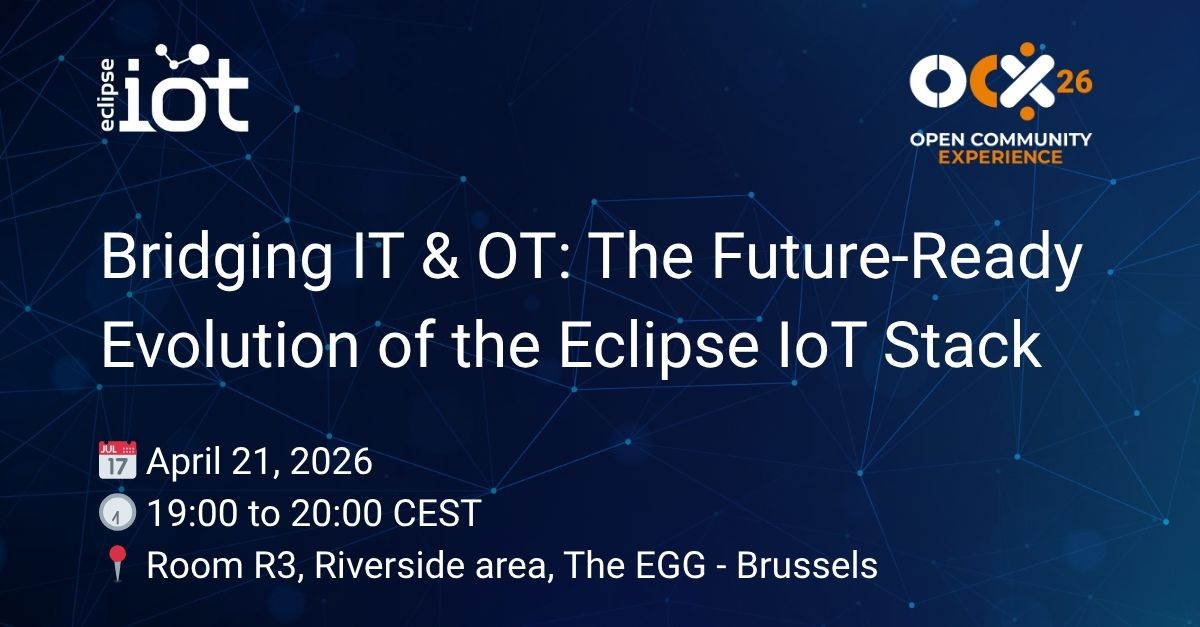
As we prepare to gather for the upcoming Open Community Experience (OCX), the Eclipse IoT Working Group is willing to show the Eclipse IoT community and others interested in the WG evolution what’s underway within the WG. OCX serves as the flagship event for the Eclipse Foundation, a premier venue where developers, architects, and industry leaders meet to define the future of open innovation. This year, our community takes center stage with a BoF session that is more than just a presentation; it is a live demonstration of a unified, vendor-neutral industrial stack.
The session, titled "Bridging IT & OT: The Future-Ready Evolution of the Eclipse IoT Stack," represents the culmination of years of engineering across several high-impact projects. We are bringing together seven distinct projects to show how the "Computing Continuum" is being realised in practice. This article explores the significance of this milestone and provides a deep dive into the technologies that form this future-ready backbone.
The OCX Flagship and the Vision of Convergence
OCX 2026 is designed to be a catalyst for open source professionals across Europe and beyond. With the introduction of collocated events like the Open Community for Automotive and the Open Community for AI, the conference highlights a broader trend: the convergence of previously siloed technology domains. For the IoT community, this convergence is best expressed in the meeting of Information Technology (IT) and Operational Technology (OT).
We are aware that the IoT field is evolving and we, as the WG at large, are also working to adapt to this evolution, rescoping the WG and aiming to foster the current projects and new initiatives that might arrive to the Eclipse Foundation. There is much to say about IoT in the next years yet. Historically, the factory floor and the enterprise cloud existed in different worlds, separated by proprietary protocols and incompatible data models. Our mission at Eclipse IoT has always been to build a bridge across this gap. At OCX, we are moving beyond conceptual discussions to show a fully integrated, software-defined industrial stack that operates seamlessly from constrained devices at the edge to the massive scalability of the cloud.
Building the Industrial Foundation
The journey across the continuum begins at the point of action: the industrial automation layer. This is where Eclipse 4diac provides the essential framework for distributed control systems. Compliant with the IEC 61499 standard, 4diac allows engineers to model complex automation logic that can be deployed across various controllers and sensors. It provides the deterministic execution and modularity required for modern manufacturing, effectively replacing traditional, monolithic PLC programming with a flexible, model-driven approach.
As these automated systems generate data, they require a messaging infrastructure that can handle the strict timing and reliability demands of industrial environments. This is the role of Eclipse CycloneDDS. As a high-performance implementation of the Data Distribution Service (DDS) standard, CycloneDDS ensures that data reaches its destination with microsecond latency and predictable performance. It is the nervous system of the stack, capable of managing mission-critical communication in robotics, automotive, and heavy industry where failure is not an option.
Securing the Gateway and Managing the Cloud
The transition from local industrial networks to the wider internet happens at the edge gateway, a critical junction for security and local intelligence. Eclipse Kura serves as the framework for these gateways, providing a modular Java/OSGi environment that simplifies the deployment of IoT applications. Kura handles the complexity of protocol translation, local data processing, and most importantly, gateway security. It ensures that data is encrypted, authenticated, and managed locally before it ever touches the public cloud.
Once data leaves the edge, it must be managed at scale, which is where Eclipse Kapua enters the unified stack. Kapua is a modular integration platform that manages the lifecycle of IoT devices and their data. It provides the "cloud-side" counterparts to Kura, offering device registries, message routing, and persistent data storage. By working together, Kura and Kapua bridge the OT/IT divide, allowing industrial assets to be managed with the same ease and security as traditional cloud services.
Fabric and Orchestration for the Continuum
To truly support a computing continuum, the stack needs a data fabric that can span across diverse network topologies. Eclipse Zenoh provides this high-speed fabric, unifying data in motion, data at rest, and computations. Zenoh is designed to run on everything from 8-bit microcontrollers to powerful cloud clusters, offering a zero-overhead protocol that adapts to the constraints of the network. It allows applications to query and subscribe to data regardless of where it is physically located, creating a transparent environment for distributed computing.
Complementing this data fabric is the need for sophisticated orchestration. Eclipse ioFog provides a complete platform for managing microservices at the edge. It abstracts the underlying hardware complexity, allowing developers to deploy and manage containers across a distributed network as if they were running in a single data center. This orchestration is vital for scaling industrial applications that require local processing but need to be updated and managed globally.
The Virtualised Future of Industry
The final piece of our unified showcase is Eclipse VOStack, a project that represents the cutting edge of IoT virtualisation. VOStack enables the creation of "Virtual Objects," which are digital representations of physical assets aligned with the W3C Web of Things standard. By virtualising industrial devices, VOStack allows for the convergence of physical hardware with cloud-native technologies like Kubernetes. It provides the abstraction needed for a truly software-defined industrial stack, where hardware can be swapped or updated without disrupting the digital services that rely on them.
This virtualised approach is a major theme for the IoT community this year. It signifies a shift toward more flexible, resilient architectures that can adapt to changing industrial requirements and the evolving regulatory landscape, such as the upcoming Cyber Resilience Act.
A Milestone for the IoT Community
For our community, the OCX BoF session is more than a technical demo; it is a statement of maturity and collaboration. Bringing seven projects together into a single, cohesive narrative proves that open source is not just a collection of tools, but a complete ecosystem capable of powering the most demanding industrial environments.
We invite all OCX attendees to join us in Brussels on April 21, 19:00 CEST, for this session. It is a unique opportunity to meet the technical leads behind these projects, see the integrated stack in action, and discuss how we are building the future-ready backbone of the industry together. Whether you are an embedded developer, a cloud architect, or an industrial stakeholder, this session offers a glimpse into a world where IT and OT are no longer two separate domains, but a single, powerful continuum of innovation.
Join us in Brussels! Don't miss out on this deep dive into the future of the industrial stack. Take a look into our BoF session and add it to your agenda. Let’s grab a drink and make team while we discuss these topics.