
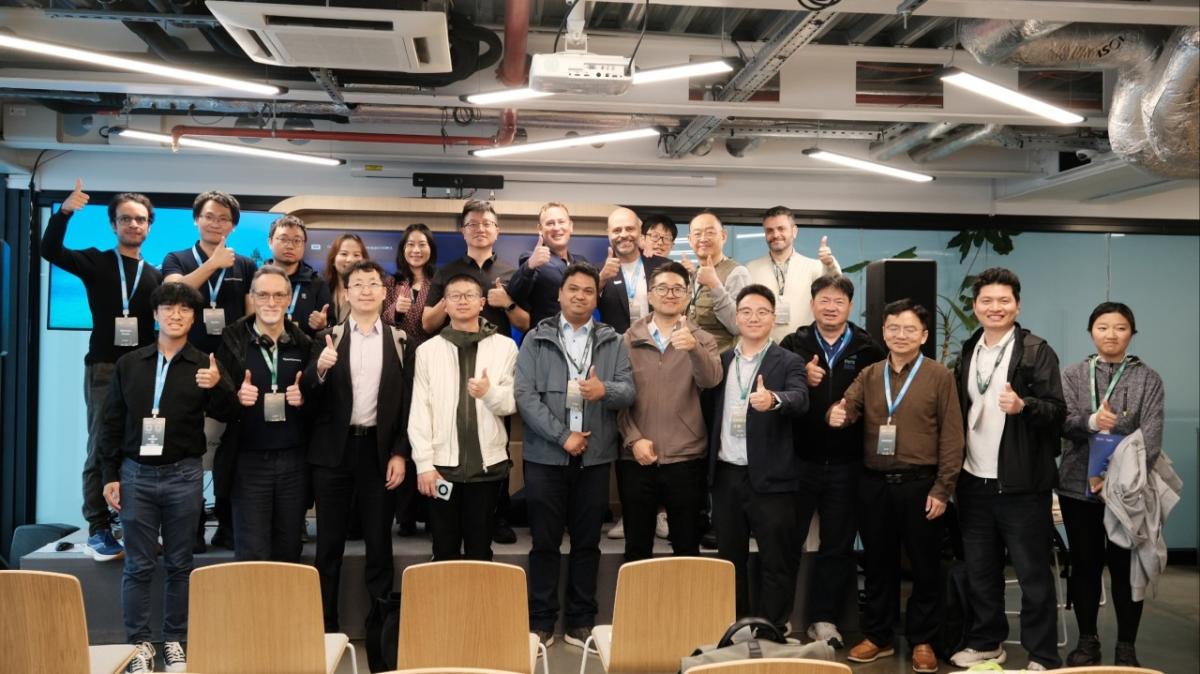
The OpenHarmony Tech Forum in Paris, held alongside GOSIM 2026, highlighted a significant shift in how we approach global device ecosystems. For the Oniro Working Group, the event was a chance to showcase our evolution around AI. We are providing the AI-driven machinery that allows OpenHarmony to scale across Western markets and integrate seamlessly with existing technology stacks.

Global Vision and System Intelligence
The forum began with a high-level look at the community’s growth. Xudong Ren, Huawei’s Chief Open Source Liaison Officer, noted that OpenHarmony has matured into one of the largest open source projects globally. He highlighted the potential of integrating AI agents directly into the operating system to unite international talent.

Following this, Ning Jia (OpenAtom OpenHarmony TSC member and Director of Huawei OS Kernel Lab) detailed the system-level evolution. As OpenHarmony becomes a device-side intelligent OS, it must navigate the integration of large models and AI agents. He addressed the technical challenges of creating self-evolving infrastructures and the security architectures required for agent-centric systems.

Oniro: The AI Bridge for Global Adoption
Representing the Eclipse Foundation, Oniro Program Manager Ignacio Ahedo explained how the project is acting as a "force multiplier" for the ecosystem. Rather than just offering another OS, Oniro is leveraging AI to solve the most common pain points in global adoption.

Ignacio highlighted how Oniro streamlines the integration of cross-platform frameworks and simplifies the porting of complex applications. Perhaps most importantly, he showed how Oniro enables the porting of the platform to existing devices, allowing manufacturers in Western markets to adopt Oniro and OpenHarmony on their current hardware portfolios. This alignment ensures that the ecosystem grows not just in new devices, but across a vast number of existing device landscapes.
New Paradigms in Interaction and Scalability
Innovation in how we control these systems is also accelerating. Debayan Roy (Principal Research Engineer at Huawei’s Hilbert Research Centre) introduced OpenDesk, a native agentic CLI. This project explores how system-level intelligent interaction can be made more intuitive through AI.

To support these interactions at scale, Xingda Wei, Associate Professor at Shanghai Jiao Tong University, shared advancements in LLM infrastructure. His work on high-performance routing and ultra-fast auto-scaling is vital for ensuring that complex AI models can be deployed efficiently in diverse, complex environments.

Boosting Developer Velocity
The "ACE revolution" within the Cangjie project, presented by Sean Dong (Program Director at Huawei’s Central Software Institute), showed the sheer power of embedded AI. By embedding AI agents across the software development lifecycle, the project has seen efficiency gains of up to 2000% in tooling.

Francesco Pham (Project Lead and Committer Representative for Eclipse Oniro) built on this by discussing how to lower the barriers to entry. His focus is on ensuring that developers and devices can integrate into the OpenHarmony ecosystem as seamlessly as possible, regardless of their starting point.

Real-World Industrial and Graphic Applications
The practical results of this collaboration were showcased by Yan Sun, Technical Architect of Yanlink. He presented a full-stack industrial IoT solution that brings together Oniro, SparkLink, and AI to solve complex connectivity challenges in the industrial sector.

Finally, Sébastien Crozet, Founder of Dimforge, explored the frontier of GPU computing. Using Rust and "Project Nexus," he demonstrated a unified approach to graphics and compute stacks, providing a high-performance path for modern applications.

Looking Ahead: Prague 2026
The momentum from Paris is just the beginning. We are already looking forward to the 2026 OpenHarmony Technology Conference, titled "OpenHarmony x AI: Powering the Next Intelligent Operating System."
The conference will take place in Prague, Czech Republic, in early October 2026. This will be a major milestone for the community to converge and see the next phase of our AI-driven roadmap. We look forward to seeing how the tools we are building today will power the intelligent systems of tomorrow.


